How Much Rent Can You Afford in London? The 30% Rule
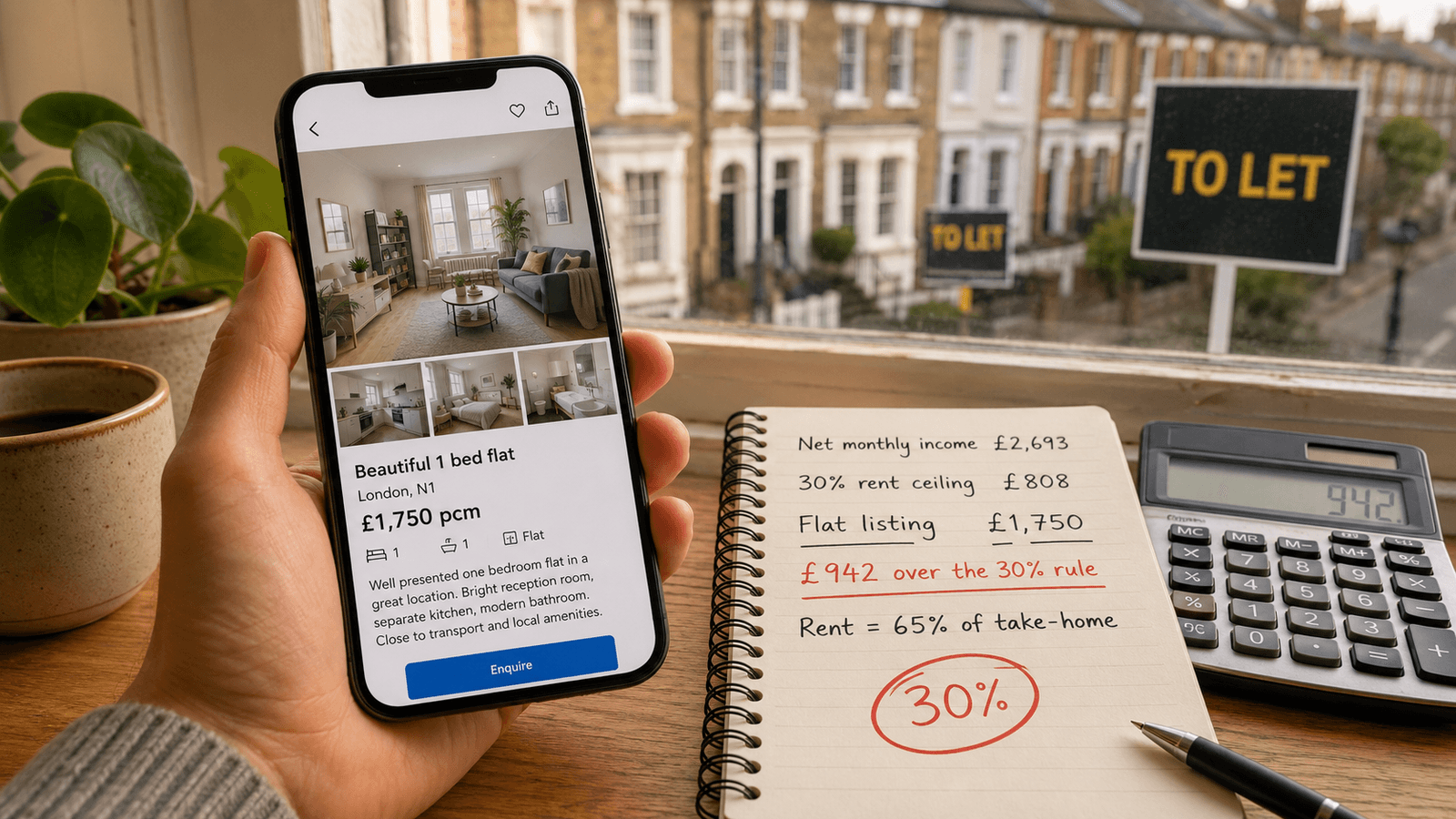
You find the flat first. It's the right size, the commute works, and the rent looks fine next to the salary in your head. You sign, you move in, you feel sorted.
Then the first month happens. Rent goes out, and behind it come council tax, the energy bill, a travelcard and the weekly shop. By the time it's all landed there's nothing spare, and you're not quite sure where it went.
That's the sum done backwards. You started from the flat and hoped your pay would stretch to cover it. The 30% rule flips the order: work out what you actually keep, take roughly a third of that as a rough rent budget, then go and look at flats. This guide runs it with real London numbers — your take-home first, then the rule of thumb, then what one-bed rents actually are in every borough.
If you want the whole monthly picture rather than just rent, our £3,000-a-month guide breaks a full London budget down line by line.
What this guide covers:
- What the 30% rule actually says
- Why it's a third of take-home, not salary
- The number the letting agent uses
- The rents, in all 32 boroughs
- Where the rule starts working again
- How to find your own number
The 30% rule, in one line
Spend no more than about a third of your monthly take-home on rent. That's the whole rule. It started as an American budgeting habit and stuck around because it's a quick gut-check: once rent eats much more than 30%, the rest of life gets tight fast.
Treat it as a rough guide, not a verdict. It doesn't know your student loan, your commute, or whether you're splitting bills with someone. It's a starting line, and it isn't financial advice — just a way to sanity-check a number before you fall for a flat.
Start with what you actually keep
The 30% is of take-home, not the headline salary, and that catches people out. Tax and National Insurance take a real bite before rent is even in the picture. Here's what a few common salaries leave you each month, and the rent budget the rule points at.
| Gross salary | Take-home a month | 30% rent budget |
|---|---|---|
| £30,000 | £2,093 | £628 |
| £40,000 | £2,693 | £808 |
| £50,000 | £3,293 | £988 |
| £60,000 | £3,780 | £1,134 |
| £70,000 | £4,263 | £1,279 |
Take-home assumes no pension contribution, England 2026/27 — figures from our take-home calculator.
One thing the table hides: most jobs auto-enrol you into a pension, so £100 to £170 a month comes off before you see it, depending on salary. That lowers your take-home, and your rent budget drops with it. Worth checking your own payslip rather than the offer letter.
Your real take-home
See what your salary actually leaves
Tax, National Insurance, pension and student loan — the number the 30% rule is really built on.
Swap in your own salary to get your figure.
Work out your take-home
Take-home calculatorThe other number: what the letting agent checks
The 30% rule is about your budget. Before you get near that, though, there's a second test — the one the letting agent runs to decide whether they will rent to you at all. It's a different question with a different answer, and it catches people out.
Most UK agents use the 30x rule: your annual salary has to be at least 30 times the monthly rent. Flip it around and you get the same thing a different way — the 2.5 rule: take your monthly salary, divide by 2.5, and that's the most rent they'll pass you for. Either way the number they use is gross — your pay before tax, not your take-home.
Say you're on £40,000. Both ways of working it out give the same number:
- 30x rule: £40,000 ÷ 30 = £1,333 a month.
- 2.5 rule: £3,333 gross a month ÷ 2.5 = £1,333 a month.
So an agent would sign you off for rent up to about £1,333. But your take-home on £40,000 is £2,693 — so that £1,333 is half of everything you actually keep, not the 30% the rule calls comfortable. The check protects the landlord's rent, not your budget. Passing it doesn't mean you can afford it.
Here's how the two ceilings compare across the ladder:
| Gross salary | Agent's ceiling (30x) | Agent's ceiling as % of take-home | 30% of take-home |
|---|---|---|---|
| £30,000 | £1,000 | 48% | £628 |
| £40,000 | £1,333 | 49% | £808 |
| £50,000 | £1,667 | 51% | £988 |
| £60,000 | £2,000 | 53% | £1,134 |
| £70,000 | £2,333 | 55% | £1,279 |
Agent ceiling = annual gross salary ÷ 30. The third column is what that ceiling works out to as a share of monthly take-home (from our calculator); the last column is the 30% the rule calls comfortable — shown for comparison.
Notice the percentage climbs as you earn more, not falls — because the higher your salary, the more of it goes to tax before you see it. Agents bend the rule a bit too: lower in a competitive area, or higher if you bring a guarantor, who's usually asked to earn 36 times the rent. The takeaway is simple. The agent's number gets you the keys. Your take-home is what you actually live on, and the two aren't the same.
Now the rents. This is where it breaks
Median one-bed rent in all 32 London boroughs, ordered cheapest to priciest, against the 30% rent budget from a £30,000, £50,000 and £70,000 take-home (£628, £988 and £1,279 a month). Every borough's bar sits above the £50,000 line; only the cheapest few dip under the £70,000 line — no one-bed comes in under 30% of take-home for a solo renter until £70k.
We took the median one-bed rent in all 32 London boroughs and lined them up against those budgets. On £30,000, £40,000, even £50,000, not one comes in under 30% of take-home for a solo one-bed.
The cheapest one-bed in London sits in Havering at £1,216 a month — 58% of a £30,000 take-home, before a single bill. The priciest, in Kensington and Chelsea, runs £2,571, more than a £30,000 take-home in full. Even on £50,000, the cheapest boroughs only reach the 30 to 40% stretch, and none actually fit.
Dropping to a studio barely moves it. The cheapest studio, again in Havering, is an estimated £997 a month, still above the £988 a £50k take-home allows. For one person renting a place of their own, the 30% rule and London rents don't meet.
It's a different story higher up. Push to £70,000 and the maths finally softens: the two cheapest outer boroughs, Havering and Croydon, bring a solo one-bed just under 30%. It's the first point where the rule and a whole flat meet. Everywhere closer in still sits above the line, but the wall stops being total.
| Borough | One-bed rent | Share at £30k | Share at £70k |
|---|---|---|---|
| Havering | £1,216 | 58% | 29% |
| Croydon | £1,251 | 60% | 29% |
| Lewisham | £1,446 | 69% | 34% |
| Greenwich | £1,527 | 73% | 36% |
| Newham | £1,622 | 77% | 38% |
| Southwark | £1,815 | 87% | 43% |
| Wandsworth | £1,910 | 91% | 45% |
| Hackney | £1,967 | 94% | 46% |
| Camden | £1,982 | 95% | 46% |
| Islington | £2,129 | 102% | 50% |
| Kensington and Chelsea | £2,571 | 123% | 60% |
One-bed rents: ONS private-rent data, April 2026, via our calculator.
Share = rent as a % of monthly take-home at 0% pension.
Where the rule starts working again
In London the rule tends to fit a room more easily than a whole flat, and splitting the rent brings 30% back within reach — one option among several, not the only way to do it. Rooms vary in size and price, so treat this as a rough split: the flat's rent divided by the number of bedrooms.
| Room in… | Rough rent | Share at £30k | Share at £70k |
|---|---|---|---|
| Croydon, three-bed | £612 | 29% | 14% |
| Bexley, two-bed | £758 | 36% | 18% |
| Newham, two-bed | £992 | 47% | 23% |
| Southwark, two-bed | £1,137 | 54% | 27% |
| Tower Hamlets, two-bed | £1,188 | 57% | 28% |
| Hackney, two-bed | £1,224 | 58% | 29% |
| Islington, two-bed | £1,320 | 63% | 31% |
Room rents are a rough split: the flat's rent divided by the number of bedrooms. ONS private-rent data, April 2026.
Share = rent as a % of monthly take-home at 0% pension.
The pattern sorts itself by salary. On £30,000 it takes a three-way share to clear the rule: a room in a three-bed in Croydon runs about £612, or 29% of take-home. The cheapest two-bed room, in Bexley at about £758, is still a stretch at 36%. On £40,000 a two-bed room clears it across the cheaper boroughs, and by £50,000 there's comfortable room to spare in the outer ones — Croydon 19%, Bexley 23%. The lower your salary, the more flatmates the rule quietly asks for.
And sharing isn't only an outer-borough, tight-budget move. Split a two-bed and the central and business patches come within reach as pay climbs. A room near Canary Wharf in Tower Hamlets, or London Bridge in Southwark, lands around £1,140 to £1,190: a stretch on £50,000, but comfortably inside the rule on £70,000. Even Islington, on the edge of the City, sits at 31% of a £70k take-home. Plenty of people sharing a flat aren't scraping by — they're buying a shorter commute and a better postcode with the rent they save. Get close enough and the commute can disappear altogether: walk to work and you save the fare entirely, which changes the maths again. It all depends on what you're after.
One practical thing before you split a place: sort the bills out at the start. Some rooms come with bills included, some don't, so check with the landlord or the other tenants and agree early whose name each bill sits under and how you're splitting them. On your own place it's worth knowing that not everything arrives monthly — some bills land quarterly, and if there's no smart meter you may need to submit readings yourself so you're billed on what you actually used, not an estimate.
Your real leftover
Pick a borough, see what's actually left
Rent, council tax, bills, travel and food for a specific borough and flat size.
Change the borough and salary to match your own situation.
Check a borough
Cost-of-living calculatorWork out your own number
Averages are a starting point, not your situation. Your real ceiling depends on your exact take-home, the borough, your bills, and whether you share. Two quick tools get you there:
- Start with your actual take-home — our calculator shows what a specific salary leaves after tax, National Insurance, pension and student loan.
- Then pressure-test a borough — the cost-of-living calculator takes your take-home, a borough and a flat size, and shows rent as a share of your pay plus what's left once everything else is paid.
If you're flexible on location, our area tool suggests boroughs that fit a budget instead of making you check them one by one. And for a single salary worked through end to end, we did the same exercise for £50k specifically.
The bottom line
The 30% rule is a rough guide, not a target. It's a fast way to spot a rent that's going to hurt before you sign, and in London it tends to point one way: toward a room in a share, unless you're earning toward the top of these figures. That's what the numbers do — where you land with it is still your call.
Plenty of people spend more than a third on purpose, and they're not being reckless. A home you actually want to come back to is worth real money, and the rule can't see that. A shorter commute buys an evening back; a place of your own buys freedom and flexibility that a few hundred saved doesn't.
Which way it falls depends on who you are. If you need your own space, sharing a kitchen and a bathroom can wear you down however good the number looks. Paying more for a place of your own is buying quiet, not wasting money — you can hit 30% and still quietly resent where you live.
Someone else feels none of that. They'd rather be near the office and the weekend than alone two zones out, and share happily to be where things are. Neither instinct is wrong, and only you know which one is yours.
The sum shifts again if you've got something bigger in mind. A cheaper room you don't love can be the plan rather than the compromise — a lean stretch while you save a deposit to buy your own place. Stretching your budget while you build toward that reads nothing like stretching forever.
So take all of this with a pinch of salt. The numbers here are a starting point, not a verdict on your life, and the things that matter most to you never show up on a spreadsheet. It's a guide to weigh against your own circumstances, not financial advice. Whatever you decide, get the order right: start from what you actually take home, not the flat you've already fallen for.
If there's one thing we'd pass on, it's that trying a few setups teaches you more than any table can. A shared place, then your own; one area, then another. Each one gives you a feel for how London actually adds up and how you'd rather live in it, and that picture gets sharper over the years. However you start, we hope this gives you a jump on it.
These are estimates to help you plan, not financial advice — see our disclaimer.