Is £50k Enough to Live in London? What It Really Leaves You
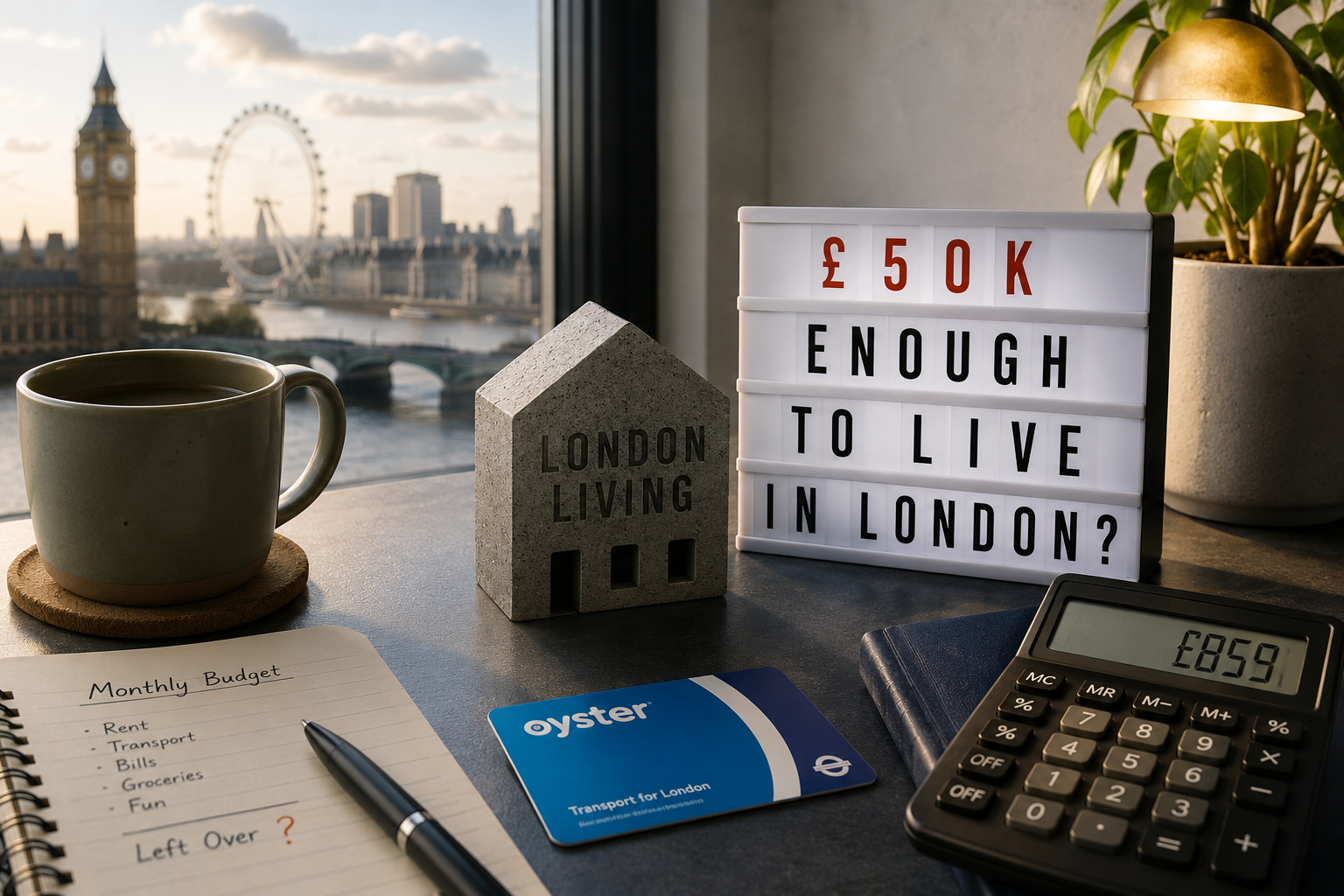
£50k is one of those salaries that sounds like you've made it. Then you start looking at London rents, and the feeling gets a bit more complicated.
On £50k, it usually works, though how comfortably depends almost entirely on which borough (basically which part of London) you pick. In a cheaper one further out you keep about £1,000 spare each month. In a pricier one closer in that's nearer £450. Right in the centre, a one-bed on your own barely leaves you anything. Same salary, very different month.
For us it crept in slowly. The pay went up to £50k, we felt flush, and the spending quietly drifted up to match. A pricier gym, the sort that runs a couple of hundred a month and swears it'll be the one that sticks. Eating out a bit more without noticing. Cabs home instead of the night bus, because we'd earned it. And the big pull, swapping a shared flat for a place of our own. None of it felt reckless. Then a few months in we looked at the account, and the pay rise had just bought a posher version of the same life. That's when £50k stopped feeling like loads and turned into a number we kept an eye on.
So we went through it borough by borough, to see what £50k actually leaves you after rent and everything else. It's a snapshot for one person. If you want the deeper version that works in net-monthly terms, the £3,000-a-month guide is the hub for that.
What this guide covers:
- What £50k actually pays you each month
- First, a quick word on boroughs
- Six boroughs, six very different months
- A worked example: £50k single in Greenwich
- Why the borough you pick is the whole answer
- When £50k starts to feel tight
- How to check your own version
What £50k actually pays you each month
A £50,000 gross salary isn't what lands in your account. Here's England, tax year 2026/27, no pension contribution:
| Item | Yearly |
|---|---|
| Gross salary | £50,000 |
| Income tax | £7,486 |
| National Insurance | £2,994 |
| Take-home (net) | £39,520 |
That's £3,293 a month to actually live on. You can sanity-check this against your own situation with the take-home calculator — pension, student loan, and salary sacrifice all move the number.
£50k gross gives you £3,293 net a month, a touch above a flat £3,000 net. So if you've read the £3,000-a-month guide, you're working with a slightly bigger number here, and the extra few hundred quid changes how relaxed the month feels.
First, a quick word on boroughs
London's split into 32 boroughs, basically the local councils, each covering a chunk of the city. Rents swing hugely from one to the next, which is why "is £50k enough" doesn't have one clean answer.
And it's not only borough to borough. Inside a single borough, two areas can feel like different cities for your wallet. Hampstead and Kentish Town are both in Camden, but their rents aren't in the same conversation. You'll see the same gap between Putney and Tooting over in Wandsworth. So treat the borough numbers below as the lay of the land, then zoom into the actual area you're eyeing.
Six boroughs, six very different months
We took £3,293 net and ran a full month of living costs for a single person in a one-bed flat (one bedroom, living on your own), across six boroughs from the centre out to the edge. Nothing changes between them but the postcode.
| Borough | Where it is | Monthly cost of living | Left over |
|---|---|---|---|
| Croydon | South, zone 5 | £2,272 | £1,021 |
| Greenwich | South-east, zone 2–3 | £2,434 | £859 |
| Wandsworth | South-west, zone 2–3 | £2,731 | £562 |
| Hammersmith & Fulham | West, zone 2 | £2,777 | £516 |
| Camden | North, zone 2 | £2,867 | £426 |
| Westminster | Central, zone 1 | £3,298 | −£5 |
Single, one-bed; England 2026/27 take-home; ONS PIPR rents 2026-04, via our calculator. Zones are London's travel rings: zone 1 is the centre, the numbers climb as you head out. Sorted by what's left after a standard month.
Out in Croydon you finish the month with about £1,021 spare. In Camden, up north and closer in, it's £426. And in Westminster, dead centre, a one-bed on your own actually puts you a few pounds under — £50k doesn't quite stretch to living alone in zone 1. Rent does nearly all the work here. Transport's loose change beside it.
What that gap really changes is how a bad surprise lands. With a grand spare, a vet bill or a last-minute train home is just annoying, you pay it and move on. On £450 it means something else doesn't happen that month, and you're checking the bank app more than you'd like by the time payday comes round. You're not skint either way. It just sits differently.
A worked example: £50k single in Greenwich
Here's one borough worked through in full, so you can see where the £2,434 comes from. Greenwich sits down by the river in south-east London.
£50k in London — where the money actually goes
Mini scenario (example)
Single • 1-bed • Greenwich • £3,293 net
Rent and transport are the fixed bits here. Move to Westminster, dead centre, and rent alone is about £2,505, which is why the same £50k leaves you nothing there. Plug in your own borough to see your version.
Plug in your rent and your borough and see your real leftover in about 60 seconds.
See your leftover →Averages hide a range. A flat in a smarter corner of Greenwich can sit above this rent, a plainer street below it, so treat it as the middle of the borough rather than a fixed price.
That ~£859 is the breathing room. It's the flight home you don't have to think twice about, or the laptop that dies without it becoming a whole thing. On £50k in Greenwich, that's yours.
Why the borough you pick is the whole answer
People ask whether £50k is "enough" like it's a yes-or-no question, but it's really a question about rent, and rent tracks how central you live.
London is roughly three rings. Further out (zones 4–6, for example Richmond and Barnet) has the cheapest rent but the longest commute. Closer in (zones 2–3, for example Camden, Islington and Wandsworth) sits in the middle. Central (zone 1, for example Westminster and Kensington & Chelsea) has the highest rent and the shortest commute. Further out means cheaper rent and a longer journey; closer in means pricier rent and a shorter one.
Croydon, right out in zone 5, runs about £1,251 a month for a one-bed. Camden, up north and closer in, is nearer £1,982, and Westminster, dead centre, about £2,505. Transport nudges the other way, since the cheaper, further-out places cost a little more to commute from, but nowhere near enough to close the rent gap. So the difference between a roomy month and a tight one mostly comes down to where you sign the tenancy.
You can't change your salary this month, but you can pick a cheaper borough. If you're weighing one area against another and want them ranked by what's actually left in your pocket, the area suggestion tool sorts boroughs by budget fit rather than vibe.
There's a catch, though, and it's why cheaper isn't always cheaper: a lower rent further out can quietly cost you back in commute time and fares. A flat that looks cheap on the rent line can lose most of that saving to a longer, pricier trip each day.
A lot of it comes down to how often you actually have to be somewhere in person. If you work from home most days, being close to the centre matters far less than you'd think, and you're freer to chase the things that make a place nice to come home to, a bit of green, quieter streets. If you're in the office most days, or you finish late, easy access starts to matter a lot, and "easy" isn't only about distance. A few lines run the Night Tube, 24 hours on Fridays and Saturdays. A flat near one of those can be the difference between a quick trip home after a late night and a long wait for a night bus. Worth weighing that before you fall for somewhere on rent alone.
And money isn't the only thing on the table. A shorter commute hands you time back, and what that's worth really comes down to you. Half an hour each way adds up to a few hours a week. If that's time you'd actually use, for the gym, for something you're trying to build, for just not being on a train, then a closer flat earning less leftover might be the better deal. Someone else would rather bank the difference and read on the train. Neither's wrong, it's just what you'd pick.
When £50k starts to feel tight
£50k for one person holds up well across most of these boroughs. It stops feeling roomy when the assumptions change.
It gets tight if you want a one-bed in a pricier borough closer in and to save hard at the same time. In Camden, on £426 spare, a couple of big weekends and a flight home can swallow most of it. Right in the centre there's barely a buffer to stretch at all. And it gets tighter again if the salary is supporting more than one person, since these numbers are all single-person, one-bed.
If you're thinking about a partner, kids, or both, this stops being the right article. A household changes the maths entirely, with childcare and a bigger flat reshaping the whole picture.
The salary itself is worth a second look, too. £50k in London versus a smaller number somewhere cheaper isn't an obvious win once rent is in the picture. And moving from abroad changes the sums again, with everything starting from scratch in that first month. Both are worth weighing before you take the London number at face value.
How to check your own version
These six boroughs are a useful map, but they're not your exact situation. Your own rent and travel habits will move the leftover up or down. A few quick checks get you to a number you can actually trust.
Start with your real take-home. £50k gives £3,293 net on standard assumptions, but a pension or a student loan changes that. The take-home calculator shows yours in about a minute.
Then your actual monthly costs. Rent and transport dominate, so a small change in either moves the leftover a lot. The cost-of-living calculator builds your month up from your own inputs.
And if you're still not sure where to look, the area suggestion tool ranks boroughs by what £50k actually leaves you, not by reputation.
For the deeper net-monthly version of this whole question, the £3,000-a-month guide is the hub. And if your number sits a bit lower, is £2,700 a month enough covers that cut.
So, is £50k enough?
So, is £50k enough? For one person, mostly yes. In a cheaper borough further out you've got real room, a grand or so spare, the sort of month where an unexpected bill doesn't throw you. Somewhere pricier and closer in still works, you've just got to keep more of an eye on it. Right in the centre, on your own, it doesn't quite get there. The thing that caught us out, looking back, was how little the salary itself had to do with how the month felt. It was mostly about where the rent was going. So if £50k's the number you're weighing up, look hard at the borough before anything else. That's the part that decides how it actually feels to live on.
These are estimates to help you plan, not financial advice — see our disclaimer.